
We have officially reached a turning point in digital media. If the 2010s were defined by smartphones and visual feeds, and the early 2020s were driven by short-form vertical video and algorithmic discovery, 2026 is defined by the complete democratization of synthetic generation and the resulting rebirth of human authenticity.
Generating a 4K cinematic video complete with custom dynamic sound design, AI-powered lip sync AI, and contextual VFX takes seconds. Yet, as the volume of digital content scales exponentially—flooding social feeds with seamless synthetic imagery—an undeniable counter-trend has taken hold. Audiences have developed a heightened sensory radar for automated fluff.
In 2026, content creation is no longer about who possesses the technical capability to produce, but who possesses the emotional depth and real-world perspective to connect.
2. The Dual-Core Paradigm: Synthetic Spectacle vs. The “Human Premium”
Social media content operates on two distinct, highly successful visual frequencies. Understanding this bifurcation is vital for creators and brand strategists alike:
Frequency A: The Infinite Synthetic Spectacle
Generative AI engines have evolved into full-fledged agentic production studios. Video models render photorealistic 3D scenes, maintain narrative continuity across multi-scene arcs, and generate localized dialect-matched voiceovers on the fly. Brands deploy synthetic avatars for 24/7 interactive livestreams, dynamically responding to user chat inputs with zero latency. For high-concept storytelling, virtual worldbuilding, and educational visualizations, synthetic media offers infinite creative leverage. None of this is speculative. An AI Video Generator does this commercially today in Higgsfield, that holds characters and camera consistent across a multi-shot sequence from a single prompt.
Frequency B: The “Human Premium” & Unfiltered Reality
Conversely, the most valuable organic asset on social media today is verifiable human realness. The rise of “imperfect posting”—unfiltered handheld camera footage, ambient background noise, unscripted stream-of-consciousness thoughts, and live physical event coverage—commands higher engagement rates and trust metrics than high-budget studio clips. Viewers actively seek proof of life behind the screen.
“When artificial media becomes frictionless and infinitely scalable, authentic human vulnerability and real-world presence become the scarcest, most expensive commodities in media.”
3. Spatial Computing and Volumetric Content Creation
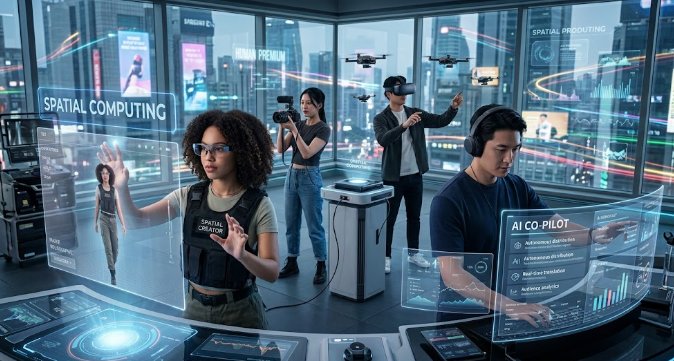
With spatial headsets and lightweight smart glasses adopted across consumer demographics, content formats have expanded beyond the 2D glass rectangle. Social platforms have introduced native spatial feed modules where content exists in three dimensions.
Creators are no longer constrained by standard 16:9 or 9:16 frame ratios. Instead, content creation involves capturing spatial depth, 360-degree Gaussian splats, and interactive volumetric moments:
-
E-Commerce & Fashion: Users step inside virtual runway shows or preview 3D volumetric garments in their own living space.
-
Fitness & Education: Instructors project life-sized volumetric instruction directly into the user’s physical environment.
-
Travel & Vlogging: Viewers walk through recorded spatial environments rather than just watching a flat video.
4. The Rise of Autonomous Content Agents
The solo creator workflow has been entirely restructured. Top creators act as Creative Directors leading an army of specialized, autonomous AI agents:
-
Research & Sentiment Agents: Continuously scan global community discussions, identifying emerging cultural signals hours before they trend on public dashboards.
-
Localization & Cultural Adapters: Automatically translate video dialogue into 30+ languages, adjusting idioms, background props, and lip-sync natively for regional feeds.
-
Multi-Format Snippeters: Turn a 60-minute interactive live broadcast into 50 platform-optimized micro-clips, each tailored to specific platform algorithms.
-
Community Co-Pilots: Manage direct messages and comment section threads with personalized, context-aware responses that mimic the creator’s conversational style.
5. SEO & Search Generative Experience (SGE) in Social Feeds
Search has fundamentally migrated from traditional web search engines into native social ecosystems. Gen Z and Gen Alpha execute over 70% of their discovery queries directly inside social search boxes and conversational AI overlays.
┌────────────────────────────────────────────────────────────────────────────────────────┐
│ KEY METRICS (2026 BENCHMARKS):                                                         │
│ • 74% of product discovery queries originate inside social media search feeds.         │
│ • 4.2x higher retention for content using direct semantic structuring & direct hooks.  │
└────────────────────────────────────────────────────────────────────────────────────────┘
To rank and achieve recommendation velocity within 2026 AI feeds, content creators must optimize for Generative Engine Optimization (GEO) and Information Gain:
-
Direct Value Delivery in the First 3 Seconds: Search algorithms transcribe audio and analyze spatial text overlays instantly. Drawn-out introductions result in immediate algorithmic downranking.
-
Semantic Entity Association: Clearly mention recognized industry terminology, entities, and verified facts within spoken dialogue and visual captions.
-
Zero-Click Strategy: Provide comprehensive answers within the post itself. External link-pushing strategies suffer algorithmic penalties as platforms prioritize native session duration.
Read Also: How to Download Instagram Reels (2026 Complete Guide)
6. Creator Monetization 3.0: Direct Equity & Synthetic Licensing
Reliance on standard ad-revenue splits and traditional sponsored posts has diminished. In 2026, creators monetize through three primary innovation tracks:
-
Synthetic IP Licensing: Creators license their digital twin, voice model, and visual style to brands or fans for personalized messages, interactive games, and continuous live broadcasts.
-
Algorithmic Micro-Subscriptions: Micro-paywalls embedded directly into social platforms allow users to pay cents per view or unlock specialized spatial content via integrated digital wallets.
-
Community Co-Ownership: Creators launch tokenized media collectives where early followers own a stake in the creator’s channel equity, sharing directly in brand revenue and product sales.
7. Frequently Asked Questions (FAQ)
Will AI completely replace human content creators by 2028?
No. While AI handles technical execution, editing, and distribution mechanics, audience loyalty is built on shared human experience, empathy, and trust. Creators who lean into authentic, real-world storytelling will thrive.
What is the most important skill for a creator in 2026?
Creative Direction and Prompt Architecture. The ability to articulate vision, curate AI outputs, verify factual accuracy, and inject genuine emotional vulnerability into content is the defining skillset.
How should brands adjust their social media strategy right now?
Shift to a hybrid model: use synthetic tools for hyper-personalized customer interactions and scale, while showcasing raw, unedited behind-the-scenes human stories for core brand building.
8. Conclusion: Strategic Roadmap for Navigating the Next Era
The future of social media content creation is neither purely human nor purely synthetic—it is an intricate synergy between human imagination and artificial capability. Visionaries who harness AI agents to handle mechanics while doubling down on empathy, real-world experience, unscripted humor, and genuine community connection will define the next decade of digital media.